In October of last year, my mom and I did an art retreat together while staying in a gorgeous cabin up at Lake Vermilion-Soudan Underground Mine State Park. We stuffed Mom’s car full of our art and craft supplies and headed up to the park on a boiling hot day. Overnight the temperature dropped and it was perfect fall weather the rest of the time we were there. We had a wonderful week together working on our own projects, making easy meals in the slow cooker, and talking.
Project Considerations
It took me some time to figure out what I wanted to work on while I was there. I wanted to try something new, and I wanted to have time and space to explore multiple iterations of that new thing. That meant it wouldn’t be a big project but would be a series of smaller explorations.
I also kept coming back to two ideas.
First, photography, whether digital or film, can be wasteful. I sometimes have to make many test prints of a photo before figuring out my final settings. My paper usage has decreased over time, in part because I’ve standardized some things through testing (using paper in the short term can save paper in the long term), in part because I’ve taken good notes and I look back on them, and in part because my darkroom decision making has gotten better. Still, I have a lot of leftover paper, and I wanted to find a way to reuse some of it, even if it was only to make prototypes of something else.
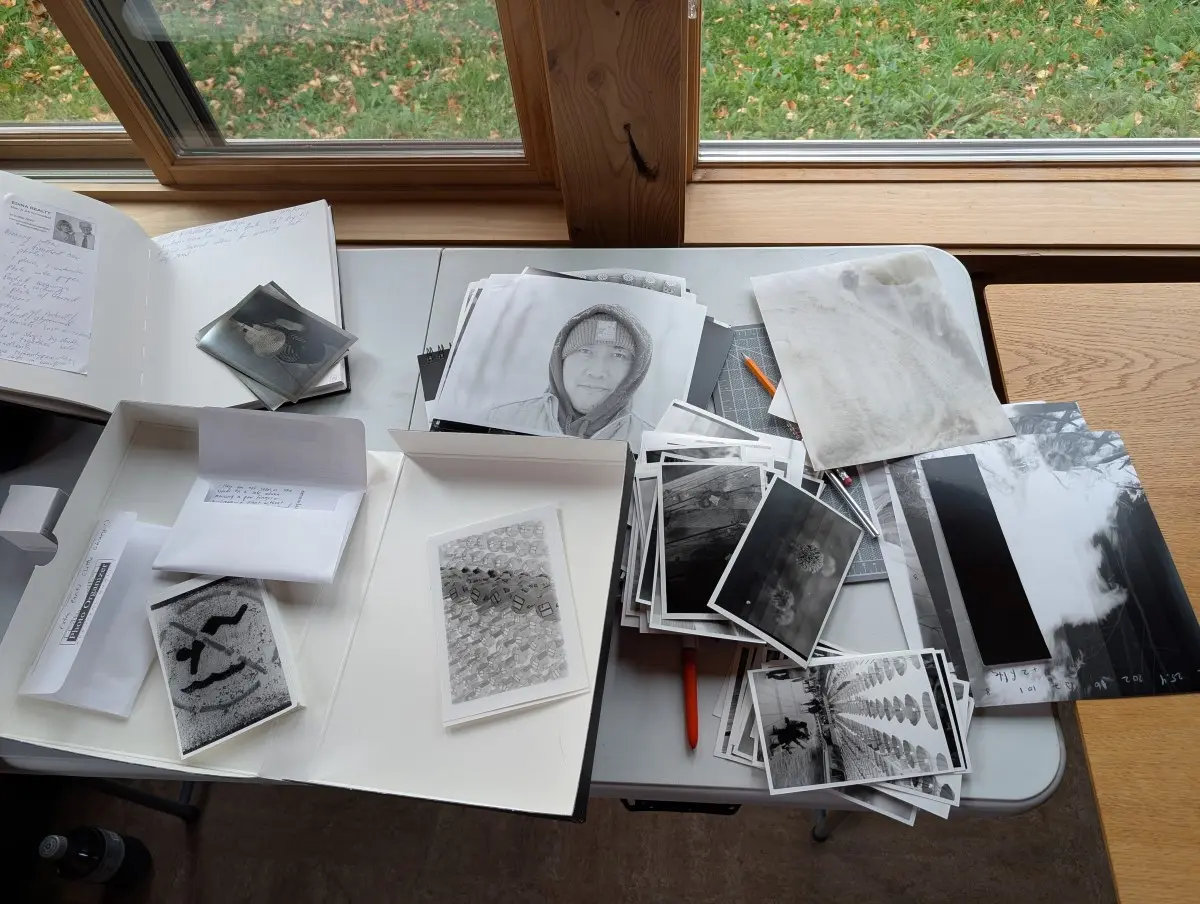
Separate from this, I’d been wondering—and am still wondering—how I might be able to combine photography and textile arts.
I’ve done a little bit of experimentation. Years ago—pre-COVID—I took a brief thermofax screen printing class at the Textile Center, and I could see how photography could fit with that. More recently I’ve done work with fabric cyanotypes, which eventually became part of my doctoral research.

I’ve seen the fabric designs others make via Spoonflower, although I’ve never done it myself. Embroidering on photos—on paper or fabric (both links open in a new tab and may autoplay)—seems to be a bit of a trend right now, and it’s something I want to try eventually. I’d also seen examples of woven photos I like, although most were in color; I did find some monochrome examples, but I worried the type of photos I take might just turn into muddied shades of grey. Guess I’d find out.
I knew one thing: in mixing photography and textiles, I wanted to find a way to keep photos in their most common state, on photo paper.
Playing with Photoweavings
I decided to focus on weaving. I wasn’t sure what that might look like, but I brought a pile of photos—test prints, extra prints, mistake prints—along with various papers, some crochet cotton, some velvet ribbon I loved the color of but couldn’t find a use for, and a grab bag of silk ribbon I’d bought at the Textile Center’s annual garage sale. I also brought some colorful paper I’d bought at Blick.
I practiced weaving photos with other photos and then I wove photos with strips of non-photo paper. I played with color, proportion, and where to start the weaving to avoid the image shifting too much.
That experimentation sent me into a new direction.

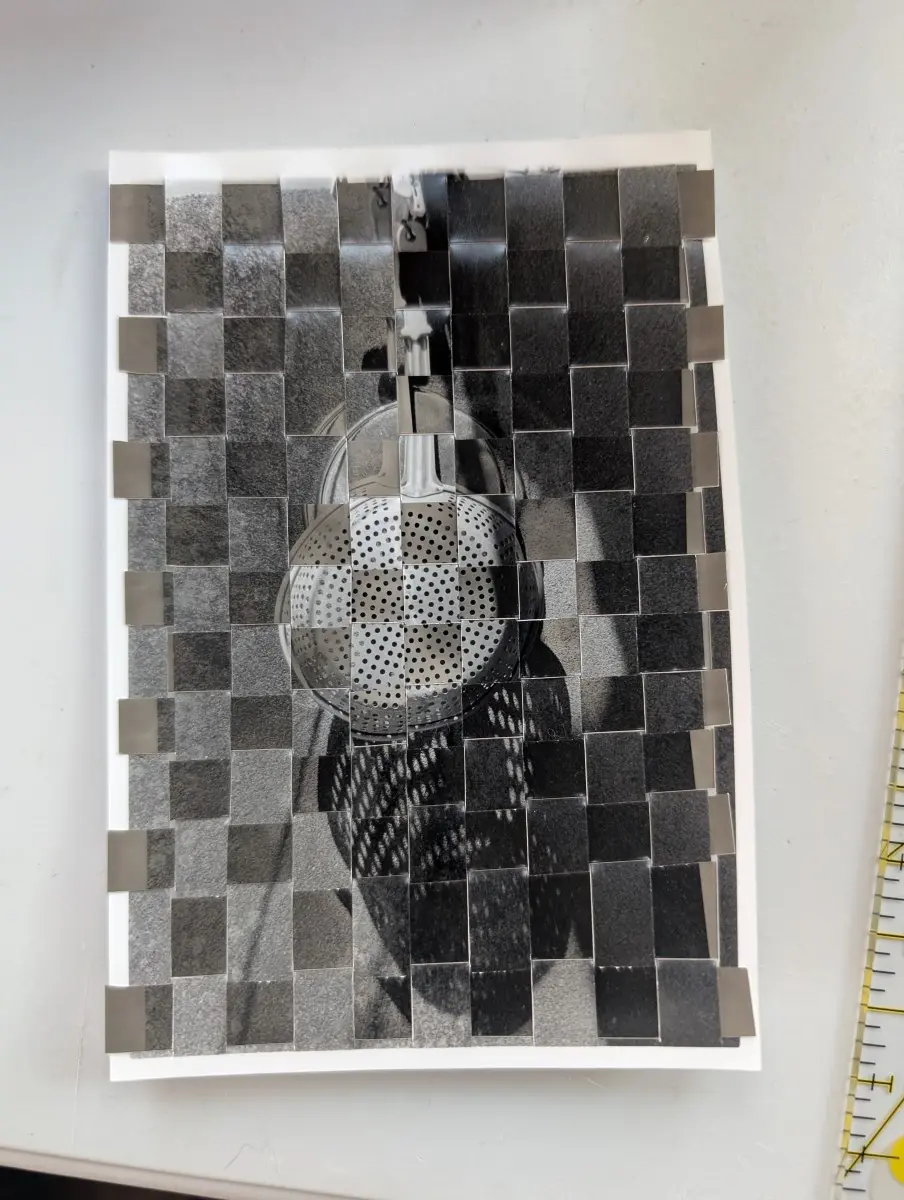


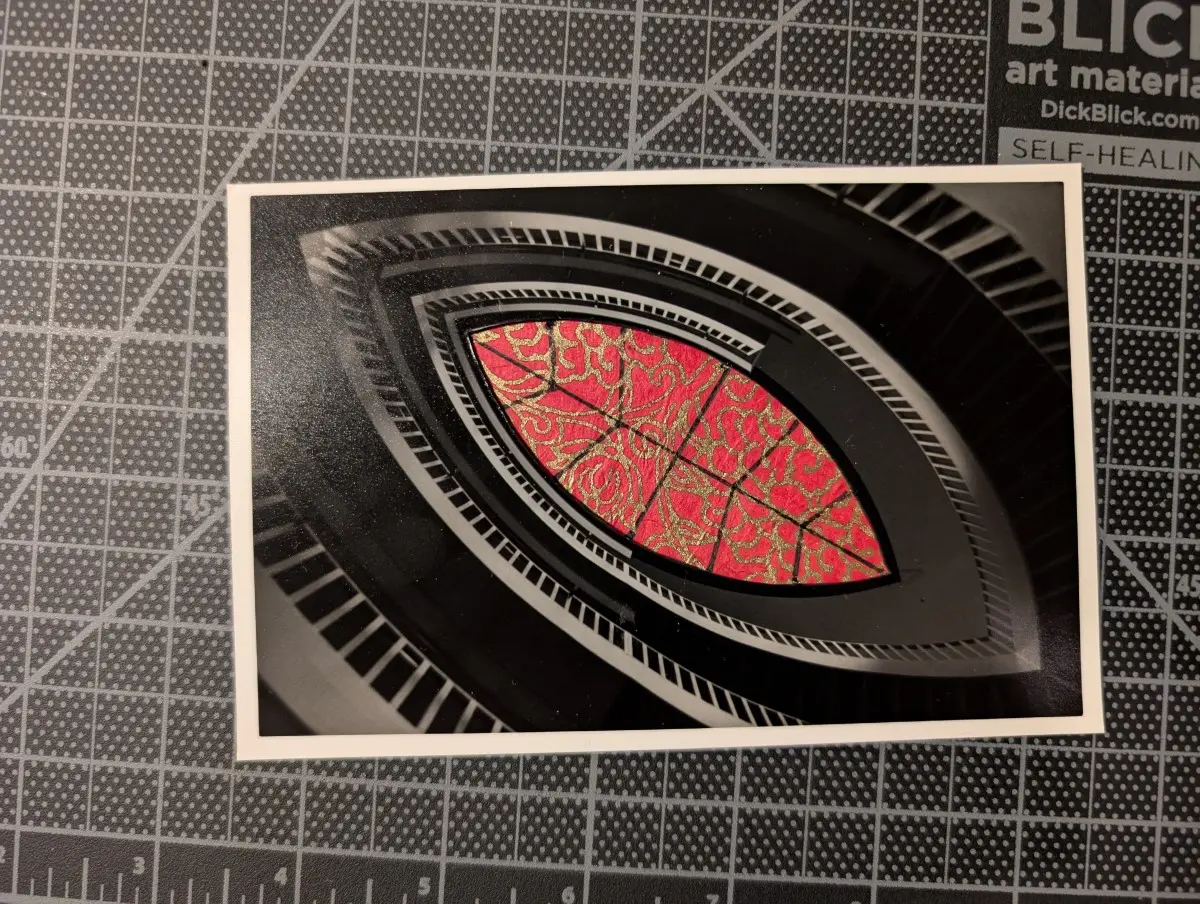
The Man, the Heron, and Cheonggyecheon
Years ago, my husband and I were in Korea for his sister’s wedding. One day we went down to Cheonggyecheon, a stream that had been underground for years before being “daylighted” about twenty years back. Along the length of the stream, there are several spots where you can cross the stream, and you can also climb back up to street level.


The area is cool and quiet and the whole feeling changes over its nearly 11 km length. It’s busiest at either end, but the center portion gets very quiet.
We were in one of the quiet spots when I took these photos.

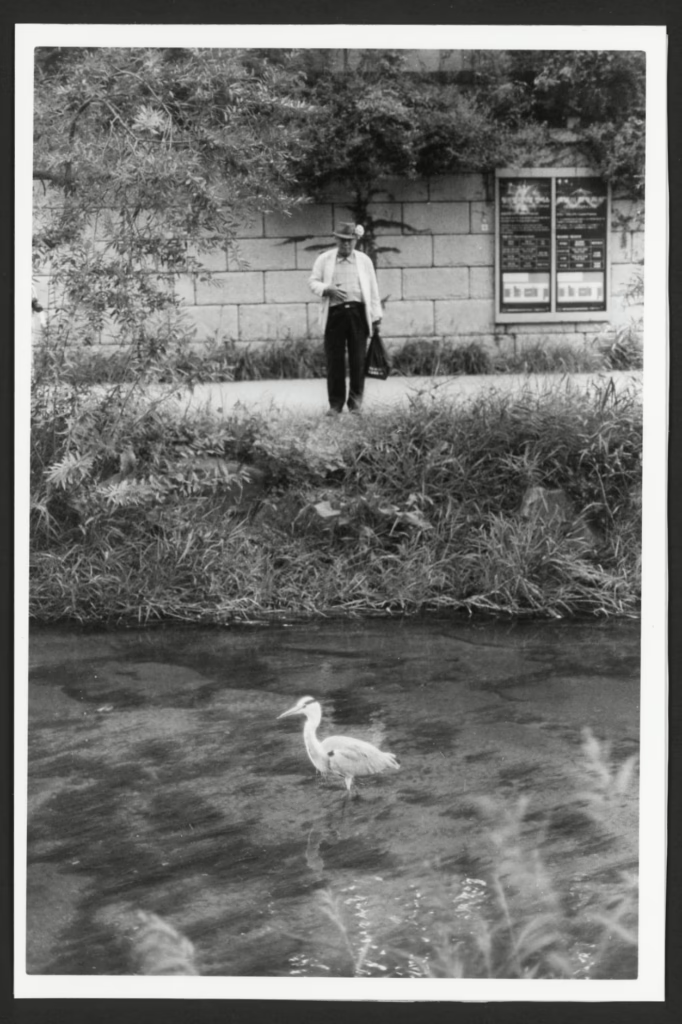
It was an October evening, the sun had just set, and there was a heron standing in the water. Across the stream, a rather dapper looking gentleman—that’s a gigantic flower on his hat!—was watching the heron. His clothing, his body language, the way he paused to watch the heron, the shallow water, the heron’s stillness… I liked all of it.
But as much as I love the photo, I didn’t love the composition of it. The man was too high, the heron was too low, and no amount of cropping could improve it.
But when I wove this (as a 4 by 6 print, I think) with velvet ribbon, I noticed how the composition changed and even improved. The photo became stretched out horizontally, and although the man and the heron are still a little too close to the edge, they feel more balanced.

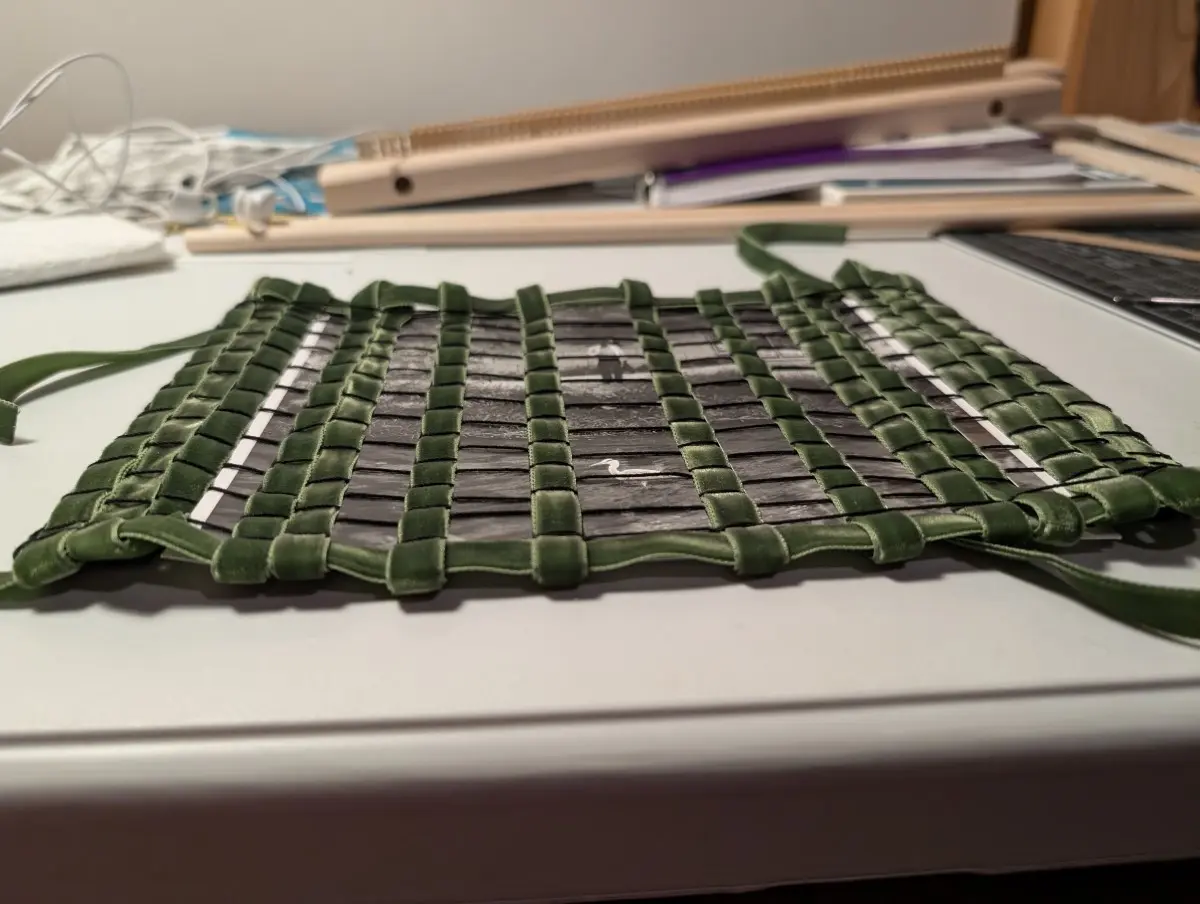

On top of that, the green velvet added a lushness that had been present in real life, but which wasn’t present in the black-and-white photo. It even added physical depth to an otherwise flat photo.
This was the last project I worked on up at the cabin, and since then, I’ve been thinking non-stop about how I might be able to combine photography and fiber arts. I’ve got a ton of ideas rolling around my head, and I can’t wait to explore them!

Leave a Reply