Living in Korea fundamentally changed me.
When I moved to Korea, I was twenty-five. I’d lived a thousand miles away from my family for years. I’d lived alone and with others, and I was settled in my career. I’d traveled domestically and abroad, mostly solo. I knew love and heartbreak. By all measures, I was no longer a child.
But Korea is where I feel like I became an adult. And this happened because I experienced the world like a toddler again.
First, some context.
I went to Korea before K-pop was a sensation in America. Korean food was not the hot thing it is now; I only had kimchi before I landed in Korea because Scott took Mark and me out to a Korean restaurant. The Hallyu wave had not reached the US, and people would sincerely ask me if I was going to North or South Korea.
The technological landscape was wildly different. YouTube and Reddit were barely a year old, and Facebook wasn’t open to the general public yet. Twitter launched about two weeks after I arrived in Korea and Instagram was still four years away.
Smartphones didn’t exist, so you didn’t carry the internet around in your pocket—although you might carry around your entire music library on an iPod. Google Translate was available, but it ended nearly all Korean translations with “bedspread.” (“I love you bedspread!” “Am hungry bedspread.”) Blogs were not peppered with advertisements and sponsored posts, but were hyper-personal diaries made public.
To communicate with anyone in the US, I had to depend on email, MSN messenger, or Skype (which was rather patchy).
Even though Korea was a very popular place to teach English, information about teaching in Korea was very limited and mostly informed by text-based discussions on Dave’s ESL Café. On top of that, if any emergencies or major issues took place, it was going to be several hours (at least) before I could let anyone back home know.
In short: The world felt bigger than it does now. The physical, cultural, and technological distance between Minnesota and Korea was vast.
As soon as I landed in Korea, I was sucked into a vortex of nonstop learning. Addresses that depended on subway stations and landmarks rather than streets and numbers. There was a new topography to learn, a new way to move about in the world. New foods, new drinks, new expectations—a whole new culture, one I did not and would not ever fit within, no matter how much I learned or how I behaved.
Even mundane activities like grocery shopping or taking out the trash were an adventure. (What do you mean eggs are on a shelf, unrefrigerated? What do you mean I’m just supposed to dump a special trash bag near a spindly tree on the sidewalk?)
And most importantly, I was learning a new language and writing system—even new sounds.
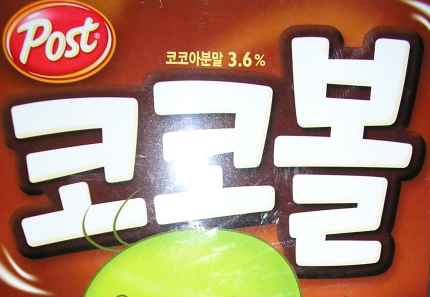
A few days before I arrived in Korea, Scott taught me the Korean alphabet, so I could sound out words, but I didn’t know what they meant. My first night in Seoul, I sounded out 코코 볼 cereal: Cocoa Ball. I was so new to reading Hangul that I didn’t even know I was sounding out an English word at first. There are letter combinations that are more frequent in English-turned-Korean words, but it would take me a few months to figure that out.
I could say “hello,” “thank you,” and “goodbye.” Thanks to the taekwondo classes I attended once a week in Atlanta, I could count to ten in one of Korea’s two counting systems.
That wasn’t much to go on, so I used a lot of pantomiming and weird vocalizations.
Near the first apartment I lived in, there was a small pizza place that made cheap personal sized pizzas in one style. I don’t remember how I did it, but about a month into living in Korea, I got the pizza woman to understand I didn’t want corn on my pizza. I was so excited she understood me!
And since I was one of the only foreigners in the neighborhood, she recognized me. “No oksusu,” the pizza woman would say to me with a nod and a smile when I bought another small pizza. (In retrospect, this was very kind of her. It’s not part of Korean restaurant culture to change anything in an order, which I didn’t understand at the time.)
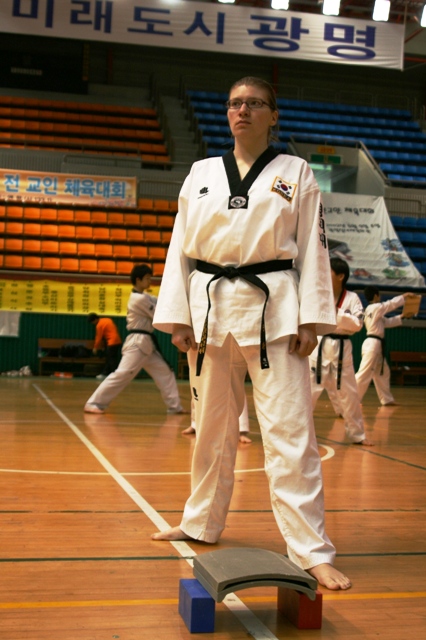
I learned most of my Korean through taekwondo.
Scott had told me that Koreans loved clubs and groups, and he encouraged me to join a club as soon as I could to help me get through the “I hate Korea” days.
Within a week of being in Korea, I joined a studio near my house. The groundskeeper at school told my boss where to take me; his son was a student there. My boss took me to the studio and introduced me to the Kwanjangnim. I gave Kwanjangnim some belt test certificate from my US studio, which was in Korean and English, not knowing that they were doing a different style of taekwondo.
I was the oldest student in the dojang. I was also the only Westerner/foreigner/white person, and Kwanjangnim didn’t speak much English. But it didn’t matter.
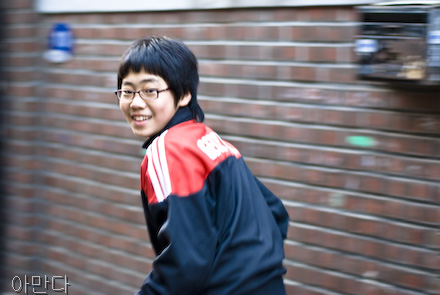
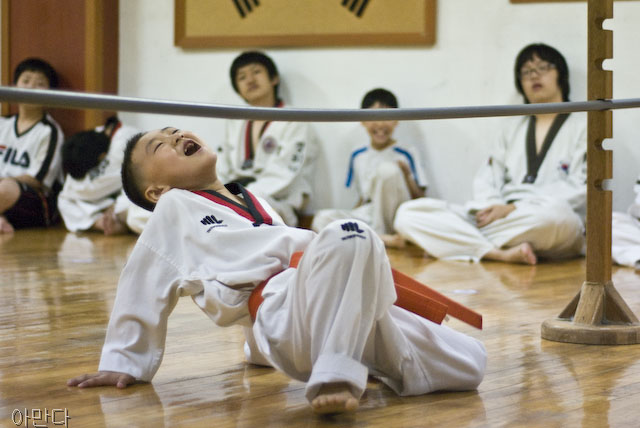
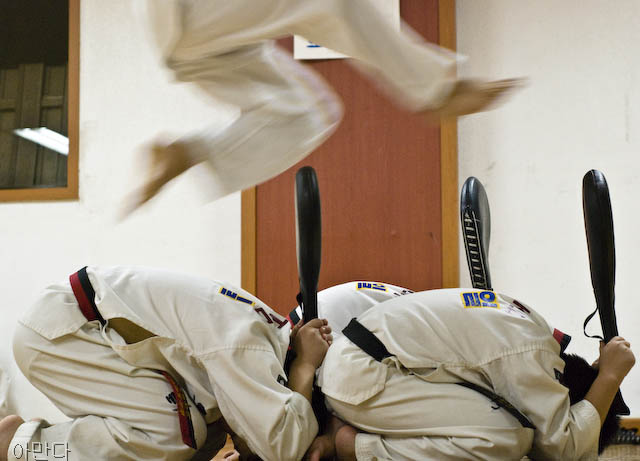
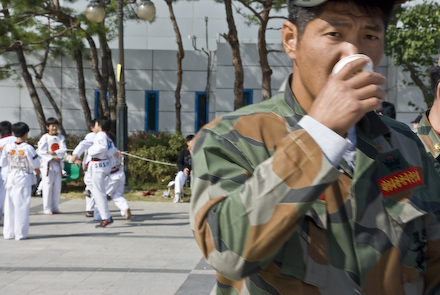
For two hours a night, Monday through Friday, I followed what everyone else was doing. They stood up, I stood up. They sat down, I sat down. At the end of the night, Kwanjangnim would shout “tong-il!” with a salute. We’d repeat it back, salute, and bow.
It was months before I figured out a) that Tongil was the name of the studio, and b) that 통일 means “reunification.” (Kwanjangnim’s brother had a studio just a few blocks away. His studio was Nambuk, meaning “south–north.”)
At first, some of the other students were very shy with me. But over time, these same students—all of whom were high school aged or younger—helped me with my Korean. I’d bring a book of Korean fairly tales and the younger kids would sit with me and laugh as I tried to pronounce words.
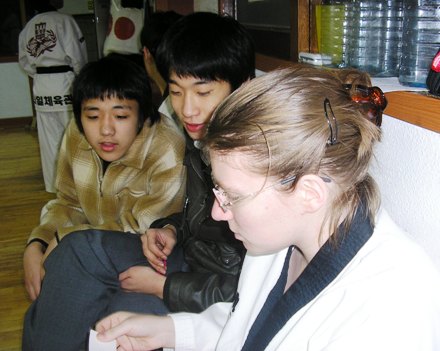
They also made sense of my errors and corrected me without any shame.
I once pantomimed “haircut” to a high school student who’d just received one. “Matshisseoyo,” I said.
He shook his head and held up his hand in a stop sign signal. “Amanda, no.”
A trip to my electronic dictionary cleared things up. Apparently “handsome” and “delicious” were not pronounced the same way, as I’d thought. The former was “meotshisseoyo” and the latter was “matshisseoyo.”
Well that explained why restaurant owners repeated “delicious” back to me when I told them their food was “handsome.” I’d thought repeating back someone’s compliments must just be some custom I didn’t understand. No. They’d been correcting me.
I also learned a ton about Korea culture through taekwondo. Kwanjangnim, who was my age, was married with two young children. His whole family—including his brother’s family and his parents—really took me under their wing. Kwanjangnim also introduced me to his friends from university.
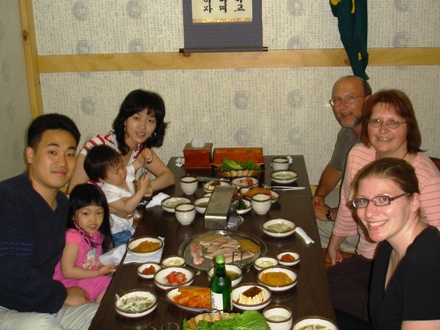
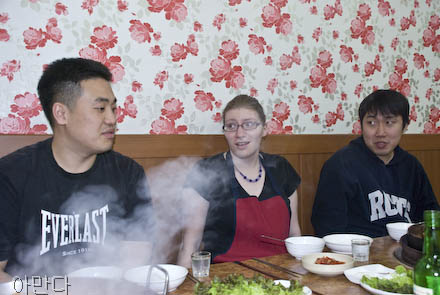
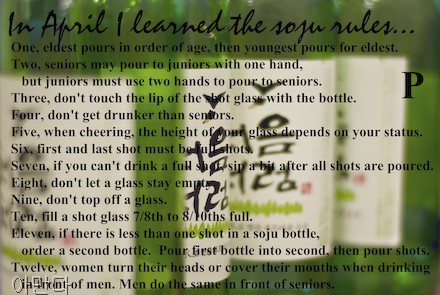
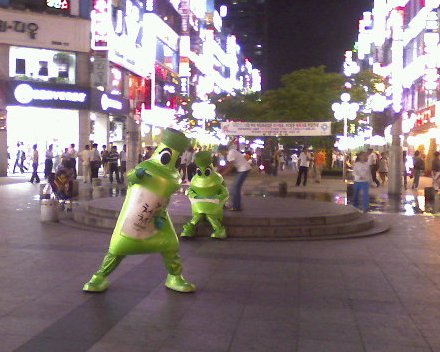
One of my favorite memories was an evening spent in Kwanjangnim’s kitchen after class. His daughter—who would have been about four years old—poured us soju while Samonim (his wife) cooked us sausages on the stove top. I discovered they had the same Old Town Blue Corelle dishes I’d grown up with, which was a delightful cross-cultural connection. That was the night Kwanjangnim taught me all of the detailed rules I needed to know to drink soju.1
What I appreciated the most was that Kwanjangnim took the time to figure out what I was trying to communicate, no matter how long it took. I never felt like he was impatient. We always figured out a way to understand each other (which sometimes meant calling in another friend for help).
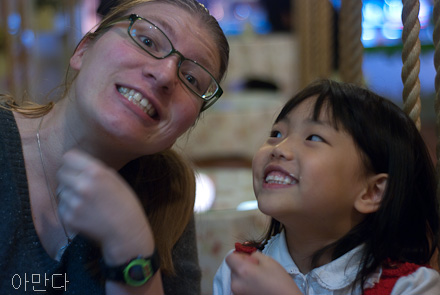
This toddler level of communication brought with it two other challenges.
First, I had to let me ego fall away. I had to be willing to embarrass myself, to look stupid. Second, I had to trust others and accept their help.2
And I found, for the most part, that Koreans were very kind. They would help me out, find someone who spoke more English, or have me follow them somewhere.
Once, I was working on some self-study homework on the subway. One woman started correcting me. Then another person started helping, and another, until I had a small crowd of people fixing my grammar and practicing verb tenses with me.
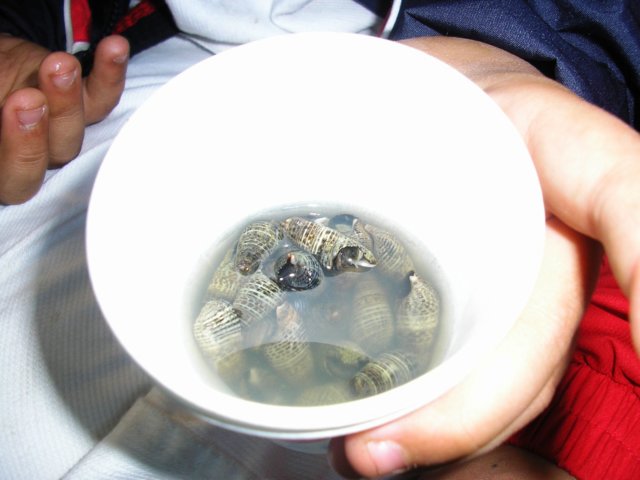
Sometimes this vulnerability turned into something magical, like when a high school taekwondo team saw me sitting alone watching the national high school taekwondo competition. They sent over their most competent English speaker, who insisted I sit with them. They shared their picnic lunch of gimbap and fruit and we chatted about taekwondo. (I declined the cooked silkworm larva and small cooked snails that the kids sucked out of the shells.)
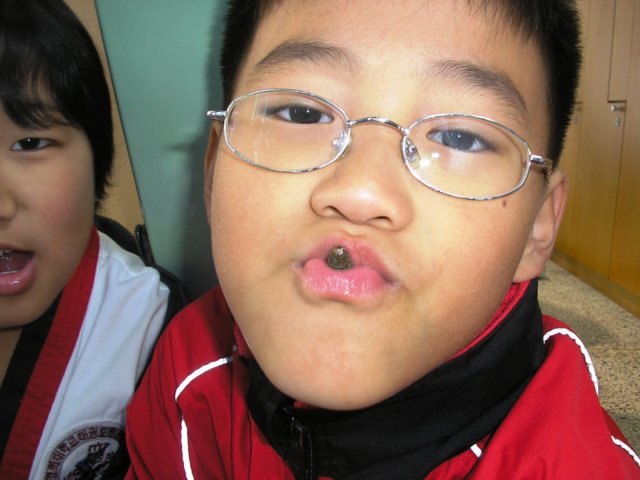
I took the subway and taxis everywhere in Korea. Once, I noticed my taxi driver had a ROK (Republic of Korea) Marine medallion glued onto his glove box. I knew that in Korea, Marines were seen as the toughest branch; and my brother, who was serving in the Marines at the time, had told me about their fierce reputation. I asked the driver if he was a Marine, and he shared that he’d served in the Vietnam War alongside the US. I told the taxi driver my brother was a US Marine. “Your brother is a Marine?”
“A US Marine,” I said.
“Oh! We are family! We are family!”
The driver refused to let me pay for my ride, saying we’re family, and to tell my—our, as they say in Korean—brother hello.
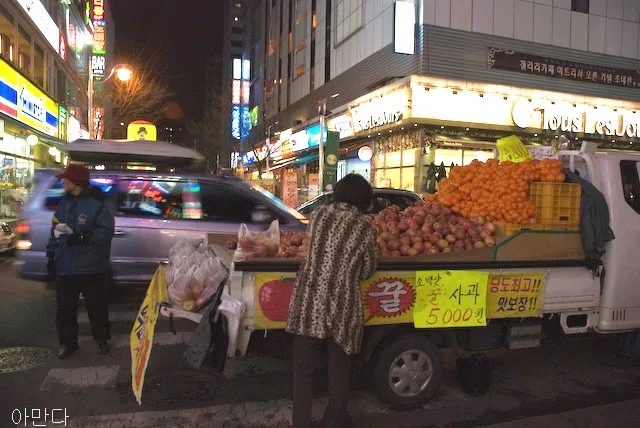
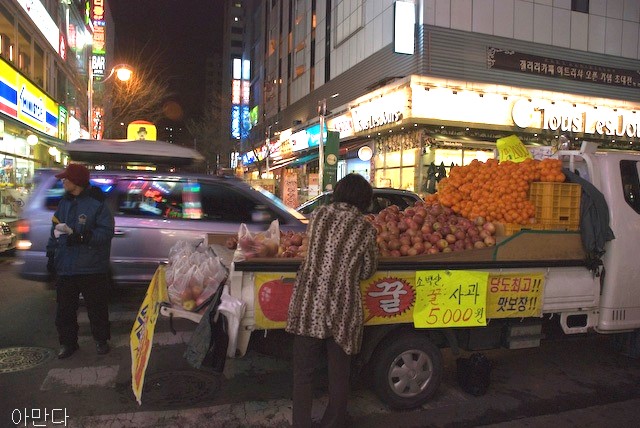
One of my favorite memories was that of the “apple ajumma.” On the way back to my apartment after taekwondo, I saw a flatbed truck loaded up with apples. The apple ajosshi (uncle) wasn’t nearby. I hung out for a minute or two and an ajumma (aunt) walked up. In Korean, she asked me where the apple man was. I said I didn’t know, I was waiting for him.
The ajumma picked up an apple, broke it in half with her bare hands, and handed me one of the chunks. “Eat, eat.”
I ate, all while wondering how in the world she’d split an apple in half with her hands. She called it delicious and then yelled out, “Apple ajosshi!” He hurried out of a local shop; she haggled with him over the price and made sure he gave me the same price.
I walked back to my apartment floating on air. She’d assumed I could understand her, she’d shared food with me, and she’d made sure I got the price she thought was fair. I felt very cared for in that moment.
I never saw her again.
There was a loneliness that came with living in a culture I’d never fit in. There was no way to assimilate in Korea. I tried my hardest to learn about Korea from my coworkers and friends and I read tons of books. But I’d always be a foreigner. Yet, there was a freedom in that too. Of course I was weird. I was American.
I was also privileged, in a strange way, to not speak the language fluently. Being able to block out other people’s conversations and focus on whatever I was doing was freeing. I wasn’t distracted by advertisements or politics. I didn’t have instant weather forecasts in my pocket. It made me focus on the immediate world around me. The here, the now.
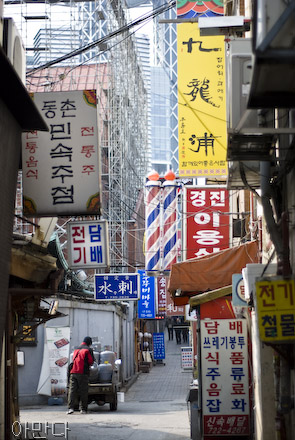
Korea forced me to be vulnerable. If I wanted to make connections with anyone other than fellow expats—and I wanted to—I had to be vulnerable.
That was a different way of moving through the world for me.
There’s one other huge change I made, because I started dating someone.
In high school I was a debator, and I was good at it. I was good at nitpicking and arguing. If you contradicted yourself, I’d catch it.
Then I studied philosophy in college and it was more of the same. Socrates was my favorite ancient philosopher, and his whole method of teaching was to politely question people until they realized he was right. (For that he was found guilty of corrupting youth and forced to drink hemlock.)
I was a strong speaker and a strong writer, and I had the Socratic method on my side. I won a lot of arguments (mostly with whomever my romantic partner was) using what I thought were my superior debating skills. I would cling to one tiny mistake in their wording, or one tiny change in their argument, and pounce.
This skill was useful in debate. I thought it was useful in my personal life. But it wasn’t useful in Korea. I wasn’t having political or philosophical debates like that with people.
Then my boyfriend and I started dating, and we got into a disagreement over something. I don’t remember what it was about. But he made some minor mistake in English, and I was about to jump on him for it—
I froze.
I couldn’t argue in Korean with him, so it wasn’t fair to use my English skills against him. If he made a mistake, I had to figure out what he meant.
I simply stopped arguing like that.
Over time, I realized that I hadn’t been “winning” arguments with people. I hadn’t shown off superior logic or argumentation skills. I’d only “won” because people got sick of me arguing in bad faith and gave up.
Well. That’s pretty shitty.
Refusing to fight like that was a huge shift in my personality. It caused a shift in my ethical stance, even.
I am much faster at noticing when others are arguing in bad faith, and I try very hard not to engage. I’ll talk about differing ideas with people who are actually interested in exchanging ideas, but I won’t argue with people for the sake of it.3
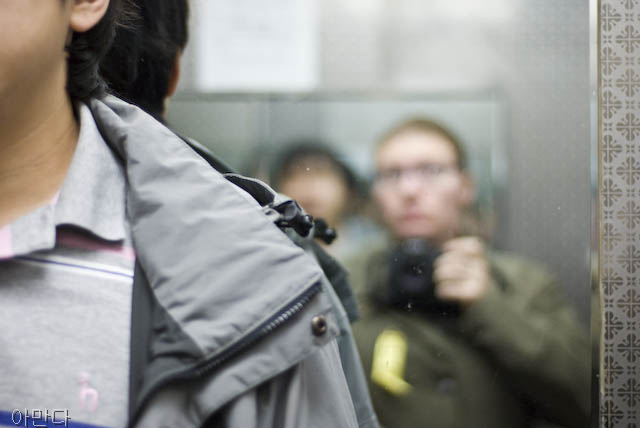
Being in Korea made me trust my gut more.
Korean culture and language are considered “high context,” meaning nonverbal cues, body language, and shared knowledge are crucial to understanding. There is a lot more reading between the lines than in America. Communication is much less direct. You have to learn to “read someone’s face.” (I’m still working on that.)
This helped sharpen my intuition.
And when linguistic understanding was limited—such as when someone would wave at me to follow them, or when a whole group of people would suddenly start moving in one direction at once—I had to decide what felt safe.
Korea taught me how to be vulnerable and made me feel like I could handle hard situations.
I know I’m looking back at on my experience with romantic eyes. Living and working in Korea was not easy. I ended up working at three schools in two years, and my recruiter helped me take one of my bosses to labor court because she stole money from me. (She still owes me thousands of dollars and a pumpkin orange fake leather couch.) There were many days I hated living in Korea or thought “K-logic” made no sense.4
I know that the Korea of twenty years ago no longer exists. And I know that living in Korea now, as a middle-aged married woman, would be much different than living there as a single(ish) woman in my mid-twenties. And if I’d become “a lifer,” the interesting would have become the mundane.
Still, I miss Korea. I miss the culture and language and people and food and inexpensive, extensive public transportation, the palaces and Kyobo Books and the floor heat and the blindingly bright night lights, the helpful strangers and the crowded markets, the cheap acupuncture and the taekwondo studios on every corner.
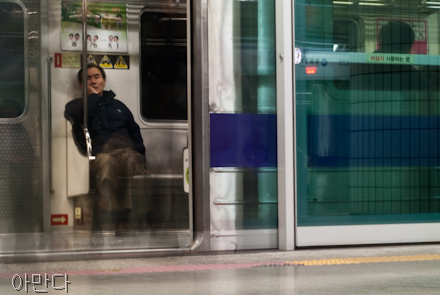
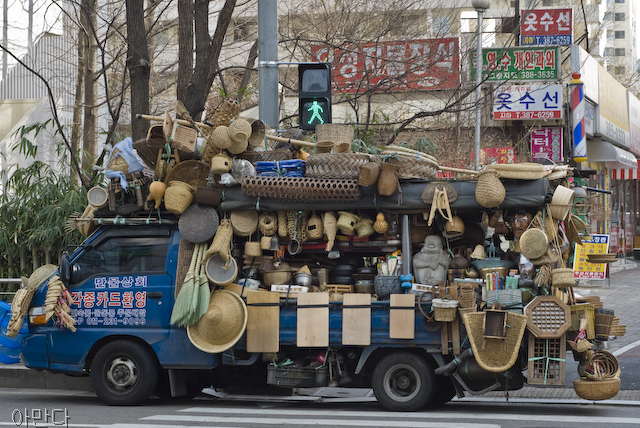
But what I miss most is the nonstop learning and the toddler sense of wonder that I had in Korea.
I look back at my life since returning to the US in 2008—a gifted ed endorsement, belly dancing lessons, teaching at so many different schools, pursing a PhD… spinning my own yarn, printing my own photos, starting a long-term art project, submitting to shows.
And I think, maybe, I’ve been chasing that feeling of deep learning and wonder for the past twenty years.
- Here are the soju rules, according to Kwanjangnim:
One, eldest pours in order of age, the youngest pours for eldest.
Two, seniors may pour to juniors with one hand, but juniors must use two hands to pour to seniors.
Three, don’t touch the lip of the shot glass with the bottle.
Four, don’t get drunker than seniors.
Five, when cheering, the height of your glass depends on your status.
Six, first and last shot must be full shots.
Seven, if you can’t drink a full shot, sip a bit after all shots are poured.
Eight, don’t let a glass stay empty.
Nine, don’t top off a glass.
Ten, fill a shot glass 7/8th to 8/10ths full.
Eleven, if there is less than one shot in a soju bottle, order a second bottle. Pour first bottle into second, then pour shots.
Twelve, women turn their heads over cover their mouths when drinking in front of men. Men do the same in front of seniors.
↩︎ - Having to let go of my ego and having to trust others made me more vulnerable and authentic. I’d like to say it stuck with me permanently, but it’s something I need to consciously practice. It’s gotten easier as I’ve gotten older, and it’s still a practice. ↩︎
- This shift in behavior impacted my experience in my PhD program. I wasn’t interested in arguing with people for the sake of it, so sometimes I didn’t participate in class conversations. I also recognize that some people are coming from such different world views that they won’t ever view arts-based research as “real” research, and I’m not interested in convincing them it’s real research. I know it’s real research. It’s just real research that isn’t meant for them.
↩︎ - One September day, the floor heat in my school was turned on and all of the windows and doors were wide open.
“Why is the ondol on?” I asked my Korean coteacher.
“Because it’s cold outside.”
“But why are the windows and doors open?”
“Oh, because it’s hot inside,” she said, wrinkling her nose.
(I still don’t understand that one.)
↩︎


Leave a Reply